
Moldovan civil society organisations convene to build defences against electoral interference
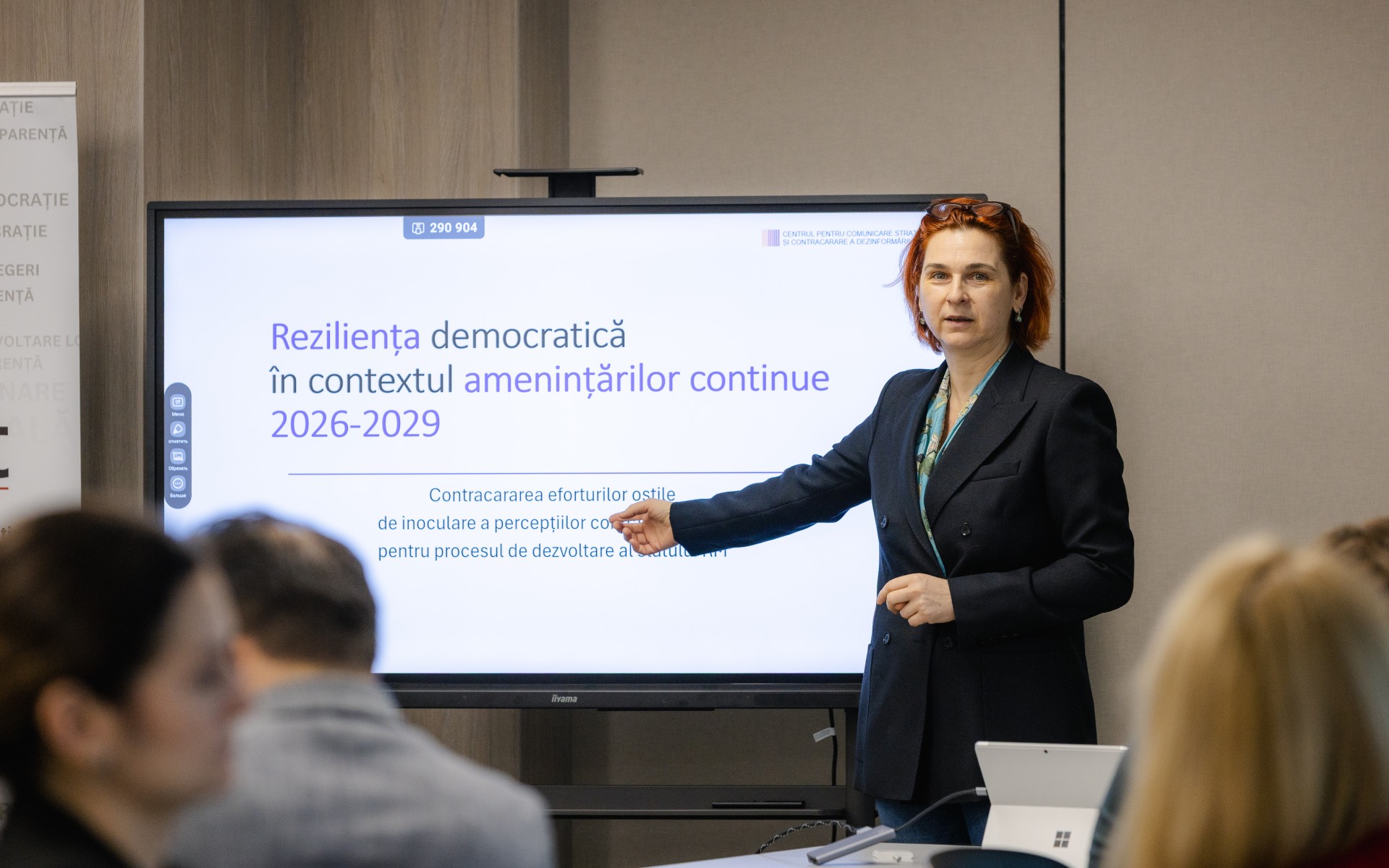
A full-day workshop in Chișinău brought together practitioners from across the country to strengthen awareness and practical capacity to counter foreign information manipulation ahead of future electoral cycles.
CHIȘINĂU, 2 April 2026 — Thirty-three representatives of Moldovan civil society organisations gathered in Chișinău on Wednesday for a national capacity-building workshop focused on foreign information manipulation and interference in elections, organised by the Association for Participatory Democracy ADEPT in partnership with the Moldovan Centre for Strategic Communication and Countering Disinformation, under the project Combating Electoral Foreign Information, Manipulation and Interference (FIMI) – Phase II, commissioned by International IDEA and supported by Global Affairs Canada.
The event, titled Civil Society in Action: Resilience against Foreign Interference, drew participants from 18 Moldovan organisations and institutions, including media outlets, legal advocacy bodies, civic monitoring groups, and community organisations. Six of the participating organisations are based outside the capital, reflecting a deliberate effort to engage civil society across Moldova's regions.
The workshop comes in the wake of Moldova's most interference-heavy electoral period on record. The 2024 presidential election and EU membership referendum, as well as the 2025 parliamentary elections, were each accompanied by documented campaigns involving coordinated vote-buying, networks of inauthentic social media accounts, and systematic efforts to erode public trust in electoral institutions. The workshop was designed to move beyond awareness and help civil society organisations identify their concrete role in building resilience.
Civil society is uniquely positioned to do this work in communities, in spaces where state institutions cannot easily reach.
— Ana Revenco, Director, Centre for Strategic Communication and Countering Disinformation
The morning programme featured expert presentations on the mechanisms and strategic logic of foreign interference, drawing on documented cases from Moldova's recent electoral experience. Experts presented evidence of how foreign actors operated during the 2024–2025 cycle, while national authorities outlined what a genuine societal resilience strategy requires in practice. In the afternoon, participants undertook structured self-assessment exercises, mapping their organisations' mandates against the interference landscape and identifying specific contributions each can make.
The day closed with a session on civic agency and organisational confidence facilitated by an expert in personal and organisational development and the first Moldovan woman to have climbed Everest. Participants concluded by making voluntary personal and institutional commitments.
Post-workshop assessments showed measurable improvements in participants' knowledge and confidence across all dimensions evaluated, with the strongest gains in understanding how interference operates at a strategic level and in recognising civil society's role in a broader multi-actor response. Participant satisfaction was high, with two-thirds rating the event as excellent and the remainder as good.
We came together not to study interference as an abstract threat, but to ask what each of us can do about it. That shift — from analysis to agency — was at the heart of the day.
— Polina Panainte, Deputy director, ADEPT
Organisers noted that gaps remain, particularly in practitioners' familiarity with the legal and regulatory framework governing responses to electoral FIMI and in organisations' confidence to act in an accountability role. Follow-up support in facilitating dialogues between CSOs and state authorities on countering FIMI is planned for the coming months.