Gagauzia: Corruption and Crisis
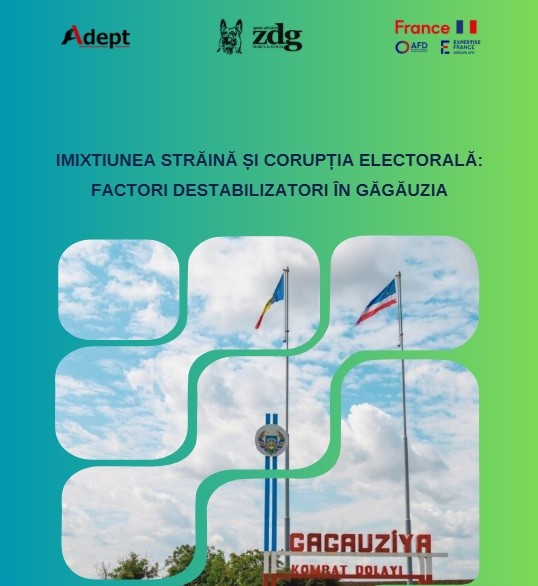
The Association for Participatory Democracy ADEPT has analysed the causes of the institutional crisis in Gagauzia in an analytical paper focused on foreign interference and electoral corruption.
The institutional crisis in the Autonomous Territorial Unit of Gagauzia is no longer merely an administrative issue, but a direct consequence of external interference and electoral manipulation. One of the key findings of ADEPT’s analytical report, titled “Foreign Interference and Electoral Corruption: Destabilising Factors in Gagauzia,” shows that the effects of the April–May 2023 gubernatorial elections have not been overcome. As a result, the region remains institutionally paralysed, with the absence of free and fair elections sustaining the deadlock.
The analysis highlights that external influence did not emerge in a vacuum. It was enabled by internal vulnerabilities, including strained relations between Chișinău and Comrat, inconsistently applied legal frameworks, and low public trust in state institutions. Within this context, a range of influence tools were deployed — from direct payments to voters to the use of humanitarian aid for electoral purposes, as well as selective support for local political actors. In documented cases, the damage linked to the misuse of external resources has been estimated at around 2 million lei, pointing to a systemic issue rather than isolated incidents.
Against this backdrop, Gagauzia has effectively become a testing ground for such practices. Methods used in the region — opaque political financing, external involvement in election campaigns, and voter manipulation — were later replicated at the national level, including during the 2024 presidential and 2025 parliamentary elections. This suggests that the issue extends beyond a single region and poses risks to Moldova’s broader electoral system.
The impact is also evident at the societal level. The institutional deadlock and the failure to hold elections for the People’s Assembly have further strained relations between local and central authorities. At the same time, society is becoming increasingly polarised along political and ethnic lines, while public confidence in the integrity of elections continues to decline.
In this context, partial measures are unlikely to be effective. The report concludes that decisive action is needed: the organisation of free and fair elections, stricter oversight of political financing, accountability for electoral corruption, and efforts to counter external influence, particularly from the Russian Federation. Only through such steps can public trust be restored and institutional stability ensured. Without them, there is a real risk that the situation in Gagauzia could become a dangerous precedent for future electoral processes across the country.
The analysis was conducted by the Association for Participatory Democracy ADEPT as part of the project “Fighting Corruption through Transparency, Information and Education,” implemented in partnership with Ziarul de Gardă, with financial support from Expertise France.