
Over 100 attacks against journalists in a single year, with only 9 reaching court
In 2025, 105 cases of attacks against journalists were officially recorded in the Republic of Moldova, yet only 9 of them reached court. At the same time, according to data presented by the Independent Press Association, more than 420 individual psychological support consultations were requested and provided last year—an indicator of sustained pressure on the profession that goes beyond the professional sphere and directly affects journalists’ safety and personal well-being.
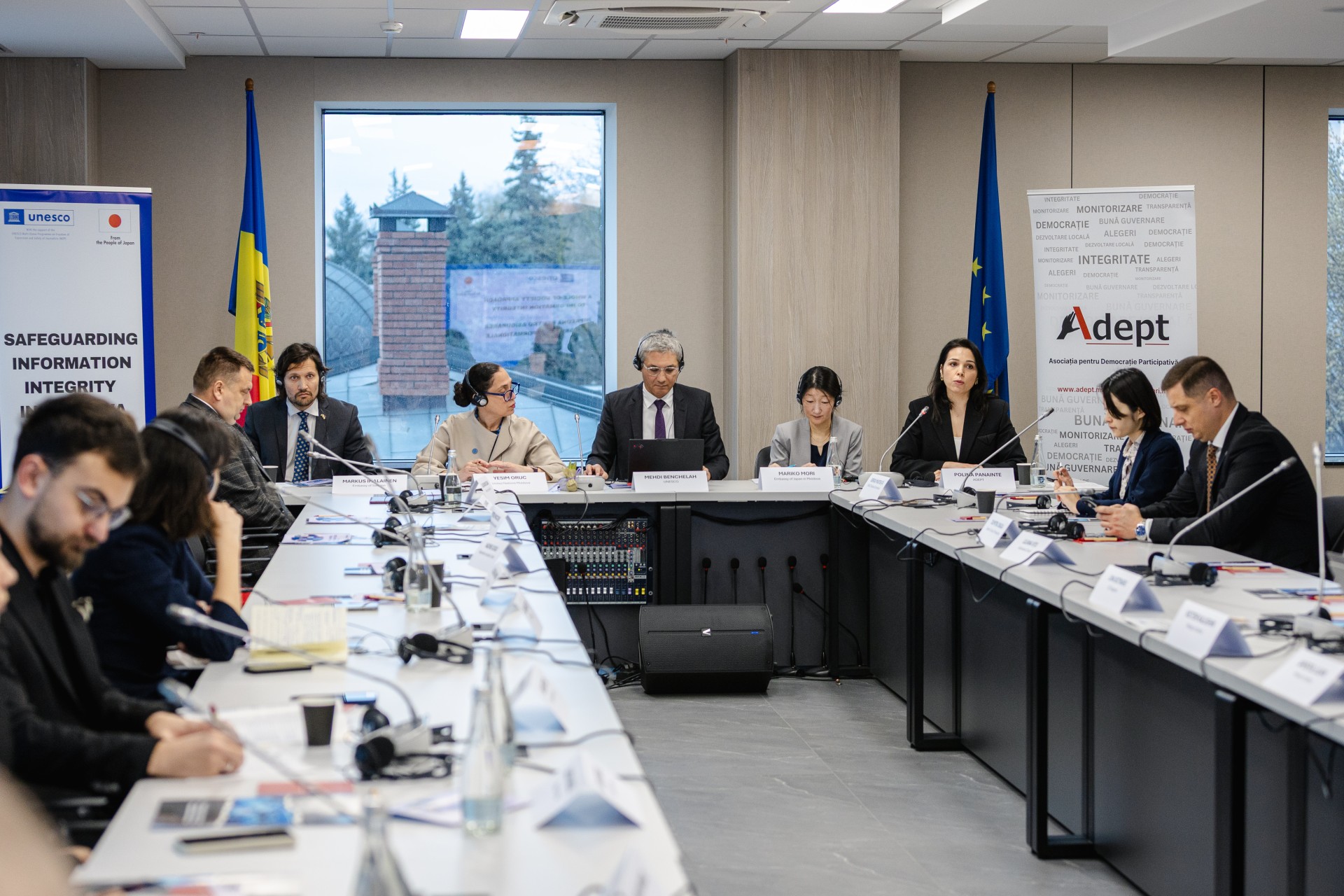
These findings were presented during today’s roundtable, “Together for Ensuring Information Integrity,” organized by UNESCO in partnership with the ADEPT Association, with the support of the Government of Japan, at a time when Moldova is working to strengthen press freedom safeguards and respond to increasingly sophisticated risks in the information space.
Participants emphasized that the issue can no longer be seen as a series of isolated incidents, but rather as a growing phenomenon affecting the normal functioning of the media. Investigative journalists in particular—those covering corruption and networks of influence—are increasingly targeted by coordinated campaigns of intimidation and discreditation.
More frequently, these pressures also take the form of strategic lawsuits aimed at silencing critical voices—known internationally as SLAPP (Strategic Lawsuits Against Public Participation). Such actions are not necessarily intended to succeed in court, but rather to exert financial and psychological pressure on journalists and media outlets through disproportionate claims and lengthy legal proceedings.
“We are seeing a growing number of attacks against journalists, and these attacks are no longer purely professional—they target individuals, their credibility, and their private lives,” said Polina Panainte. According to her, national authorities, together with institutional and international partners, are currently working to align legislation with European standards, establish inter-institutional coordination mechanisms, and develop clear response protocols in cases of intimidation or violence.
At the international level, developments in Moldova are being closely monitored. “It is becoming increasingly easy to influence perceptions and undermine public trust without people even realizing it,” said Mariko Mori, representative of the Embassy of Japan in Chișinău, stressing that protecting information integrity is essential for stability and peace.
Global data confirms the trend: pressure on the media is rising, while impunity remains a major concern. “Globally, around 86% of crimes against journalists go unpunished, and self-censorship is on the rise,” said Mehdi Benchelah, UNESCO representative, noting that this reflects not only external risks but also an internalized fear affecting the profession. In this context, UNESCO promotes a comprehensive approach involving state institutions, the judiciary, and civil society, alongside investments in media and information literacy.
In Moldova, the institutional response is gradually strengthening, but challenges remain. In recent years, amendments have been introduced to the Criminal Code and the Contravention Code, providing clearer sanctions for obstructing journalistic activity, including cases of intimidation, threats, or violence, as well as stronger protections for journalistic sources and safeguards against undue interference in media work. Aggravating circumstances have also been introduced for offenses committed against journalists, including in online environments or during public demonstrations.
At the same time, authorities are working on a new media law aimed at modernizing the legal framework and aligning national legislation with European standards, including in the areas of countering disinformation and protecting the information space. “We have strengthened the legal framework for the protection of journalists, including clearer sanctions and stronger safeguards for source protection,” said Liliana Nicolaescu-Onofrei, Chair of the Parliamentary Committee on Culture, Education, Research, Youth, Sport and Media.
Participants concluded that the protection of journalists can no longer be treated as the responsibility of a single institution. A comprehensive approach is needed—one that brings together legislation, enforcement, institutional cooperation, and societal resilience. Because every attack on a journalist is not just an isolated incident, but a direct indicator of the state of democracy.
The roundtable “Together for Ensuring Information Integrity” was organized by the UNESCO Multi-Donor Programme on Freedom of Expression and Safety of Journalists (MDP), in partnership with the ADEPT Association, with the financial support of the Government of Japan. The views expressed belong to the speakers and do not necessarily reflect the position of the donor.