
ADEPT: Clearer Rules for Political Competition and Public Funding
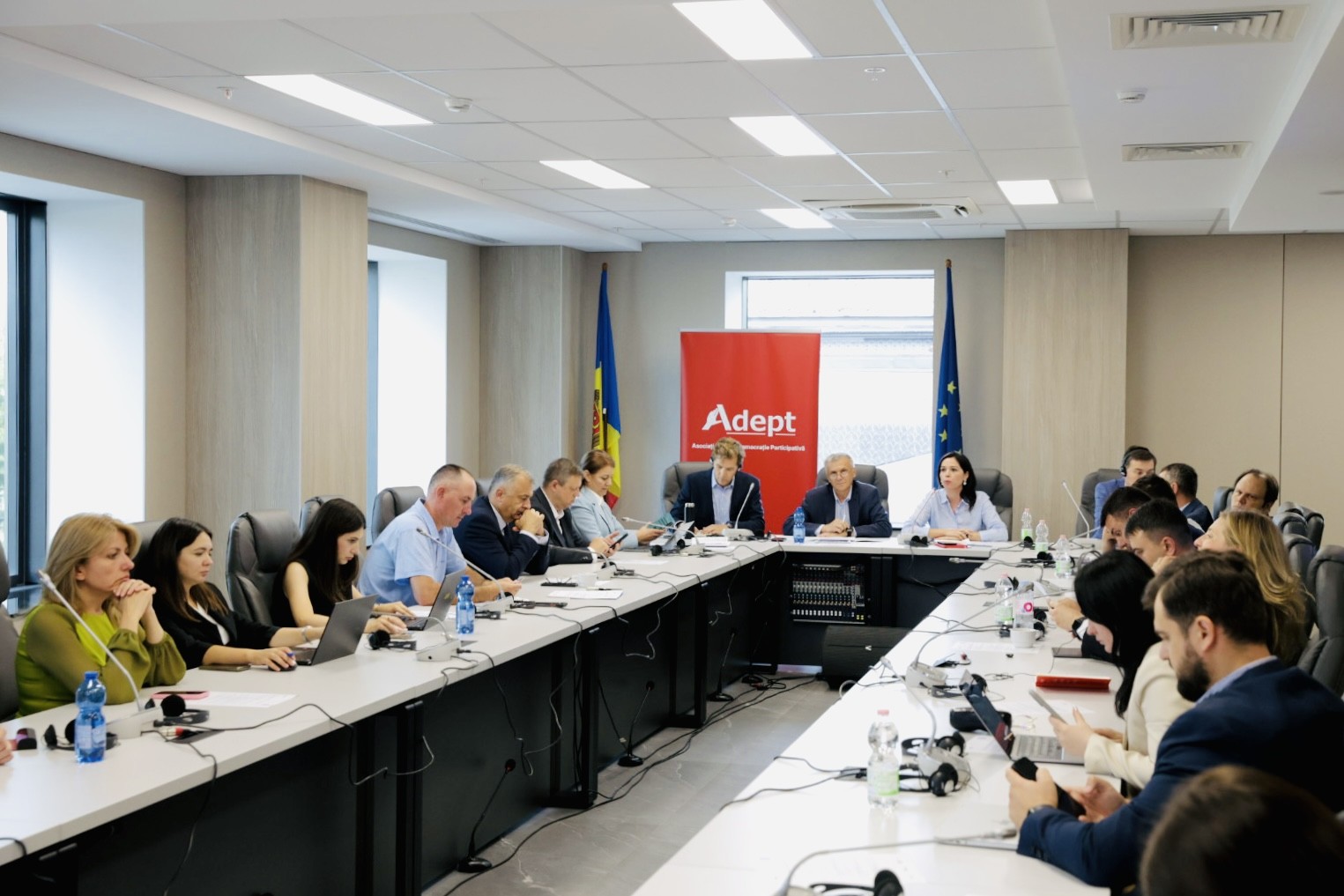
On 13 July 2026, during the public dialogue "Adjusting the Legislation on Political Parties in the Republic of Moldova," the Association for Participatory Democracy ADEPT presented a package of proposals aimed at improving the legislation governing political parties, electoral legislation, and the related legal framework. The proposals were developed on the basis of the recommendations of the Venice Commission and the conclusions of the 2026 Electoral Forum.
The recommendations were prepared by ADEPT experts Igor Boțan and Polina Panainte, together with international expert Fernando Casal Bértoa. The event brought together the leadership of the Central Electoral Commission, representatives of parliamentary and extra-parliamentary political parties—including both the parliamentary majority and the opposition—as well as representatives of civil society, who participated in the presentation and public discussion of the proposals.
Experience from recent electoral cycles has demonstrated that certain provisions of the current legal framework may produce disproportionate consequences or lead to inconsistent interpretations. In some cases, political parties have faced the risk of being excluded from electoral contests due to administrative non-compliance, while other situations have exposed ambiguities concerning registration procedures, public funding mechanisms, or the application of sanctions. According to ADEPT experts, these challenges do not require changing the democratic rules themselves, but rather refining them to ensure that the law is applied consistently, proportionately, and predictably.
One such example concerns the 2025 parliamentary elections, when a political party was excluded from the list of eligible contestants because several administrative documents were submitted after the legal deadline. ADEPT proposes that the legislation explicitly provide political parties with the opportunity to remedy such administrative deficiencies before the most severe sanction—exclusion from the electoral contest—is imposed, in line with the principle of proportionality recommended by the Venice Commission. The organization also recommends that decisions concerning party registration be clearly reasoned and subject to full judicial review.
The package of proposals also addresses the use of public funds allocated for financing political parties. Currently, more than 60 political parties are registered in the Republic of Moldova. According to data from the Central Electoral Commission, more than MDL 62 million was allocated for public funding of political parties in 2025, of which approximately MDL 59 million was distributed to 29 political parties. In 2026, the allocated amount increased to more than MDL 66.6 million, distributed among 44 political parties—nearly double the number of beneficiaries compared to the previous year. In ADEPT's view, state subsidies should more accurately reflect the genuine level of public support enjoyed by political parties and contribute to the development of active and accountable political organizations.
In this context, ADEPT proposes that public funding be granted only to political parties that receive at least 2% of the valid votes cast in parliamentary or local elections. The proposed threshold is lower than the electoral threshold required to obtain seats in Parliament and is intended to provide meaningful opportunities for extra-parliamentary parties that demonstrate genuine public support. At the same time, the organization proposes that a portion of public funding be distributed based on membership fees paid by party members, thereby encouraging the development of parties with a genuine membership base and sustained civic engagement, rather than organizations active only during election campaigns.
The document also includes proposals to clarify the eligibility criteria for participation in elections, strengthen procedural safeguards for political parties, limit the use of classified information as the sole ground for refusing party registration, and introduce a graduated system of sanctions. Under the proposed approach, warnings, fines, or temporary restrictions on party activities would be applied before dissolution, which would remain an exceptional measure reserved for the most serious violations, in accordance with the recommendations of the Venice Commission.
Overall, the package of proposals seeks to strengthen the integrity of the electoral process by establishing clearer rules for all political actors, more transparent administrative procedures, more efficient use of public funds, and stronger safeguards for the protection of fundamental rights.
The document has been submitted to public authorities, political parties, and civil society organizations for consultation and public debate on further improving Moldova's electoral and related legal framework. The full set of proposals is available on the ADEPT website:
https://www.adept.md/ro/products/article/propuneri-privind-ajustarea-legislaiei-electorale-i-a-legislaiei-conexe-din-republica-moldova