
Local elections after amalgamation: how do we ensure community representation?
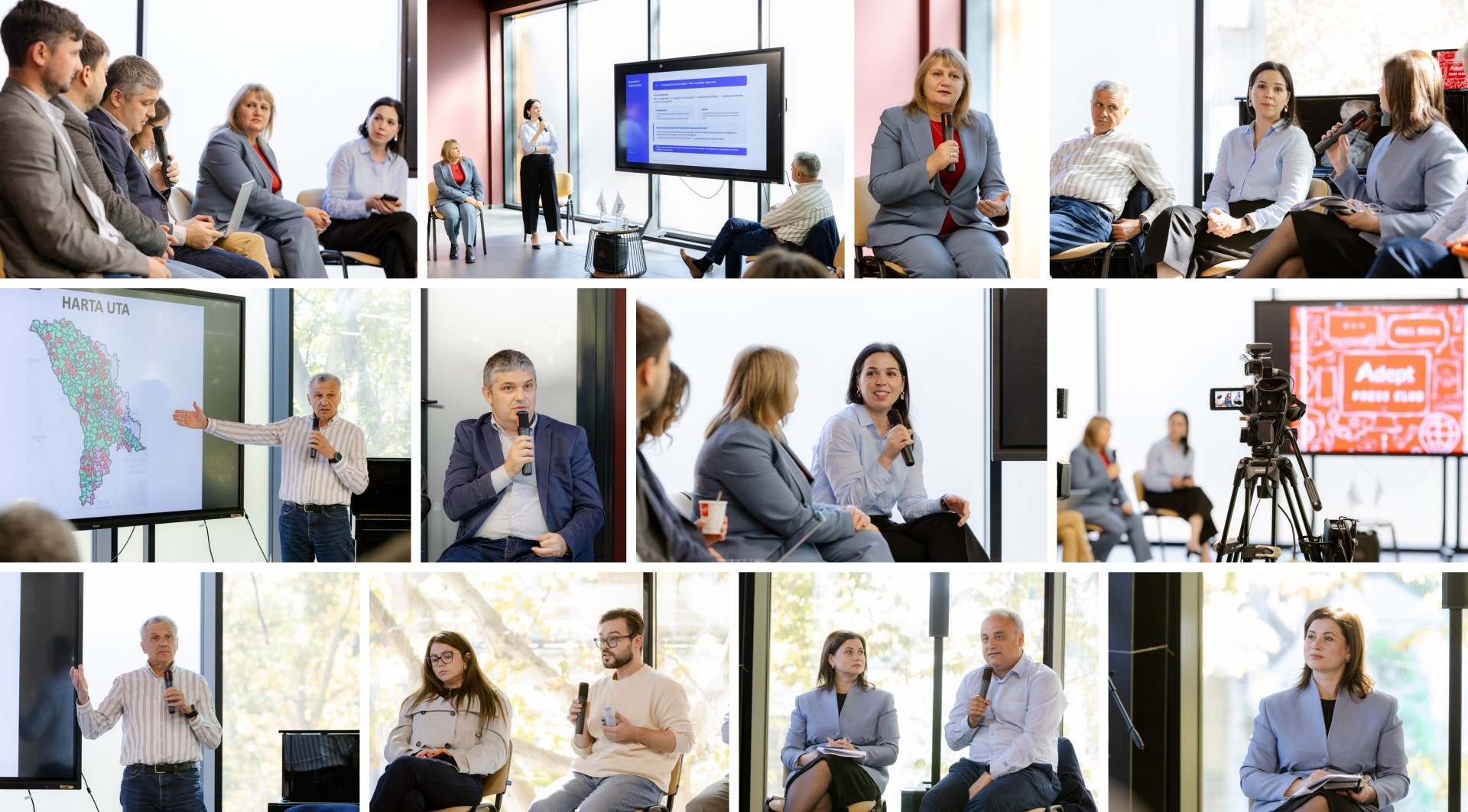
The Association for Participatory Democracy ADEPT hosted a Press Club on 29 September 2026 to discuss how communities within newly amalgamated administrative-territorial units could be represented on their local councils, as preparations get under way for the 2027 general local elections.
ADEPT opens discussion on options for representing localities in the councils of amalgamated administrative-territorial units.
Voluntary amalgamation transforms both the organisation of local public administration and the way citizens will be represented at local level. After amalgamation, communities that elected their mayor and local council separately will jointly take part in electing a single local council for the new administrative-territorial unit.
Under the current electoral system, all localities within an amalgamated unit jointly elect a single local council. Each locality may end up with representatives on the council, but this is not guaranteed by law and depends on the composition of the candidate lists and on the election results.
At the event, ADEPT presented the draft policy paper "Representation of Constituent Localities in the Local Councils of Amalgamated Administrative-Territorial Units: Public Policy Options for the 2027 General Local Elections". The document compares several possible solutions, without promoting any particular model in advance.
The analysis examines five scenarios:
- retaining the current electoral framework, including the possibility of enhancing transparency by indicating each candidate's locality of domicile or residence;
- creating electoral subdivisions for the units participating in the current amalgamation process, with a share of seats allocated among them;
- extending the system of subdivisions to localities integrated into units in earlier periods, on the basis of general criteria;
- introducing a transitional mechanism for the first term following amalgamation, including a temporary increase in the number of councillors, an approach also inspired by Poland's experience;
- complementary mechanisms for local participation, such as community representatives or consultative bodies, without altering the system for distributing seats on the local council.
The discussions focused on the advantages, limitations and implications of each option for voters, electoral contestants, local authorities and electoral administration. Particular attention was given to how political representation across the whole unit can be balanced against the interest of constituent communities in maintaining a visible and effective link with local decision-making.
The Press Club was attended by representatives of the State Chancellery, the Parliament of the Republic of Moldova and the Congress of Local Authorities of Moldova (CALM), together with ADEPT experts and media representatives.
The discussion also underscored the need for any decisions on amending the electoral framework to be taken sufficiently far in advance of the 2027 local elections. Some of the scenarios analysed would require legislative amendments, new rules for the allocation of seats, adjustments to candidate registration procedures and to the systems administered by the Central Electoral Commission (CEC), as well as appropriate voter information.
The draft policy paper will be finalised taking into account, among other things, the observations and perspectives presented at the Press Club. The document will then be submitted to the relevant institutions and published by ADEPT, to contribute to the continuing debate on community representation in the new architecture of local public administration.
The event and the policy paper were produced by the ADEPT Association with the support of the project "Strengthening Democratic Resilience in Moldova", implemented by UNDP Moldova and funded by Norway, Sweden and Denmark.
The content of this material is the responsibility of its authors and does not necessarily reflect the views of the United Nations, including UNDP, UN Member States or the donors.