
Dialogue on the Future of Regional Elections in Gagauzia
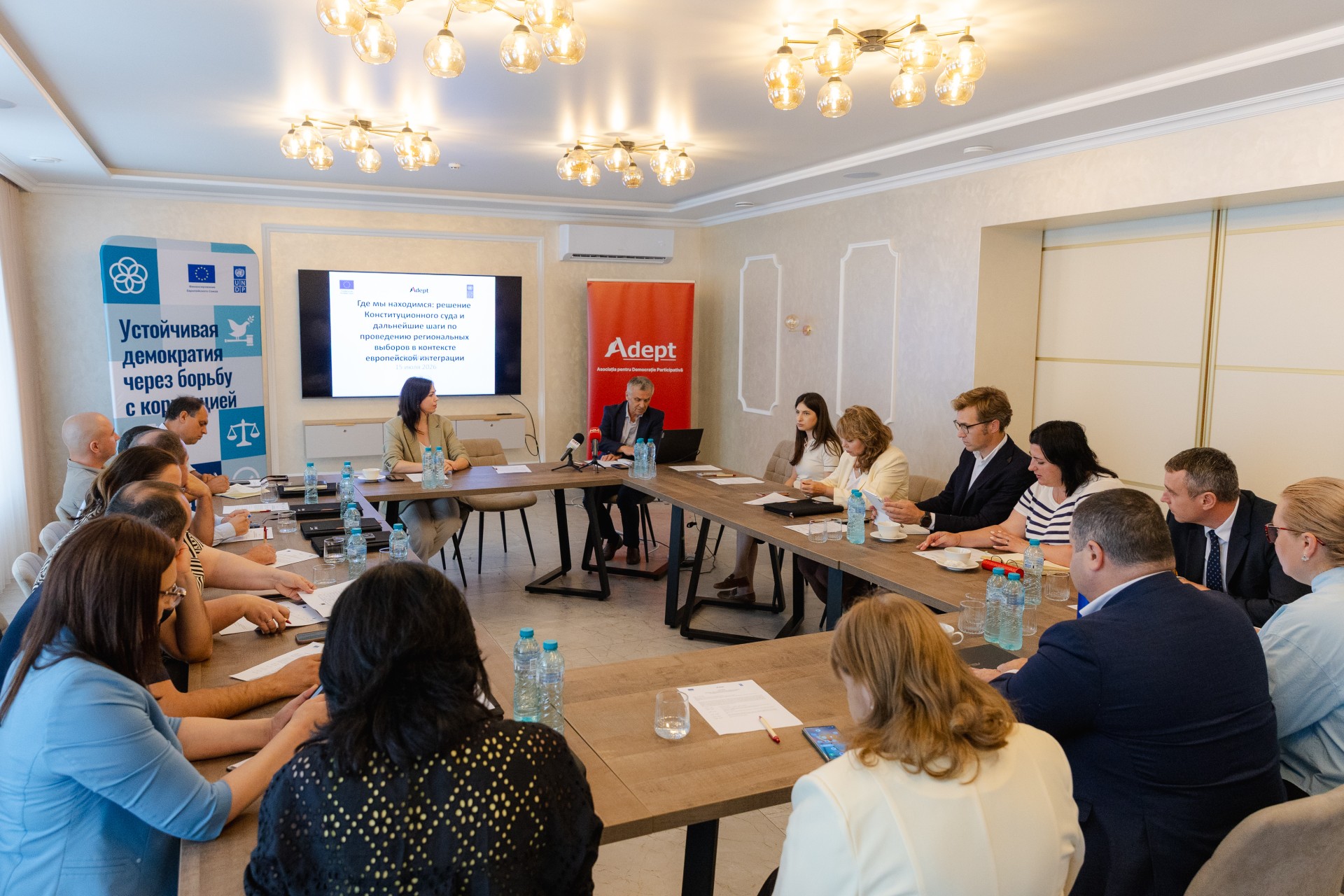
The Association for Participatory Democracy ADEPT brought together, in Avdarma, mayors and local councilors from the Autonomous Territorial Unit (ATU) of Gagauzia, Members of Parliament of the Republic of Moldova, experts, and civil society representatives for a public dialogue on regional elections and proposals to align the electoral legislation with the Constitutional Court's ruling of July 2026.
The discussion took place against the backdrop of the prolonged deadlock in organizing elections to the People's Assembly of Gagauzia, which have been stalled for nearly a year. In its ruling of 9 July 2026, the Constitutional Court declared unconstitutional the provisions granting the People's Assembly the authority to call, organize, and administer regional elections, and instructed the Parliament of the Republic of Moldova to harmonize the legal framework governing the autonomy.
Opening the event, ADEPT Executive Director Igor Boțan outlined the evolution of the legal and institutional framework governing elections in Gagauzia, explaining the circumstances that led to the Constitutional Court's decision and the available options for overcoming the current impasse. His presentation provided participants with a shared understanding of the legal and institutional developments that have shaped the autonomy, reviewing the constitutional framework, the recommendations of the Venice Commission and the Council of Europe on harmonizing electoral legislation, as well as European examples of regional autonomy governance.
The discussion highlighted the concerns of local public authorities regarding the impact of the current institutional deadlock on communities across the autonomy. Oleg Constandoglo, Mayor of Cioc-Maidan, stressed that institutional instability has affected not only the work of local authorities but also the region's economic development. "No investor is willing to come to a region where there is no stability," he noted, calling for renewed dialogue between the central and regional authorities and for greater involvement of mayors in identifying solutions for the upcoming regional elections.
Member of Parliament Larisa Voloh reaffirmed Parliament's responsibility to draft the legislative amendments required by the Constitutional Court's ruling, emphasizing that the process must fully respect democratic principles. "We must find solutions that ensure free and transparent elections without compromising the principles of democracy and the rule of law," she stated, advocating for stronger cooperation between central, regional, and local authorities.
For his part, Member of Parliament Igor Chiriac stressed that the common objective should be to organize elections that genuinely reflect the will of citizens and strengthen public trust in democratic institutions. "Today's discussion demonstrates that there is openness and that solutions exist. We need a clear and predictable legal framework that enables elections in which the right of the residents of the autonomy to vote and to stand for office is fully respected in accordance with the highest democratic standards. This kind of dialogue is precisely how we achieve that," he said.
Ecaterina Jecova, journalist and civic activist from ATU Gagauzia, called for stronger involvement of civil society in consultations on the future electoral framework and for clearer public communication regarding the implications of the Constitutional Court's ruling. In her view, the current situation provides an opportunity to develop electoral procedures that will prevent the shortcomings identified during previous regional elections from recurring.
Polina Panainte, Deputy Executive Director of ADEPT, emphasized that the significance of the discussion extends well beyond the autonomy itself and concerns the quality of the electoral process throughout the country. "Free and fair elections require transparent campaign financing, rules that are applied equally to all contestants, and zero tolerance for voter bribery. Only when campaign funding is transparent and votes are neither bought nor influenced can citizens—whether in Chișinău or Comrat—make informed, responsible, and genuinely free electoral choices," she stated.
She added that the deficiencies previously identified in Gagauzia—from opaque campaign financing to pressure on voters—are not isolated regional issues but rather the same vulnerabilities that undermine electoral integrity nationwide. "This is why discussions such as the one held in Avdarma matter for the entire Republic of Moldova. Clarifying the legal framework here is a test of our collective ability to guarantee the same democratic standard for every voter, regardless of where they live," she concluded.
The debate reflected a range of perspectives on the legal and institutional solutions for organizing regional elections. Nevertheless, participants shared the common conviction that dialogue remains the only viable path toward establishing an electoral mechanism that complies with the constitutional framework while responding to the expectations of the people of Gagauzia.
The event was organized by the Association for Participatory Democracy ADEPT within the framework of the UNDP project "REDACT – Resilient Democracy through Anti-Corruption", funded by the European Union.
Similar activities
- Strengthening the dialogue between the People’s Assembly of Gagauzia, civil society and citizens of ATU Gagauzia
- ADEPT is launching two projects with the aim of supporting the advancement of reform in public administration and improving the skills of local elected officials.
- Local Development Partnerships and Community Engagement – Initiatives of ADEPT’s School of Local Elected Officials