
Judges and Prosecutors Trained to Counter Abusive Lawsuits Against Journalists
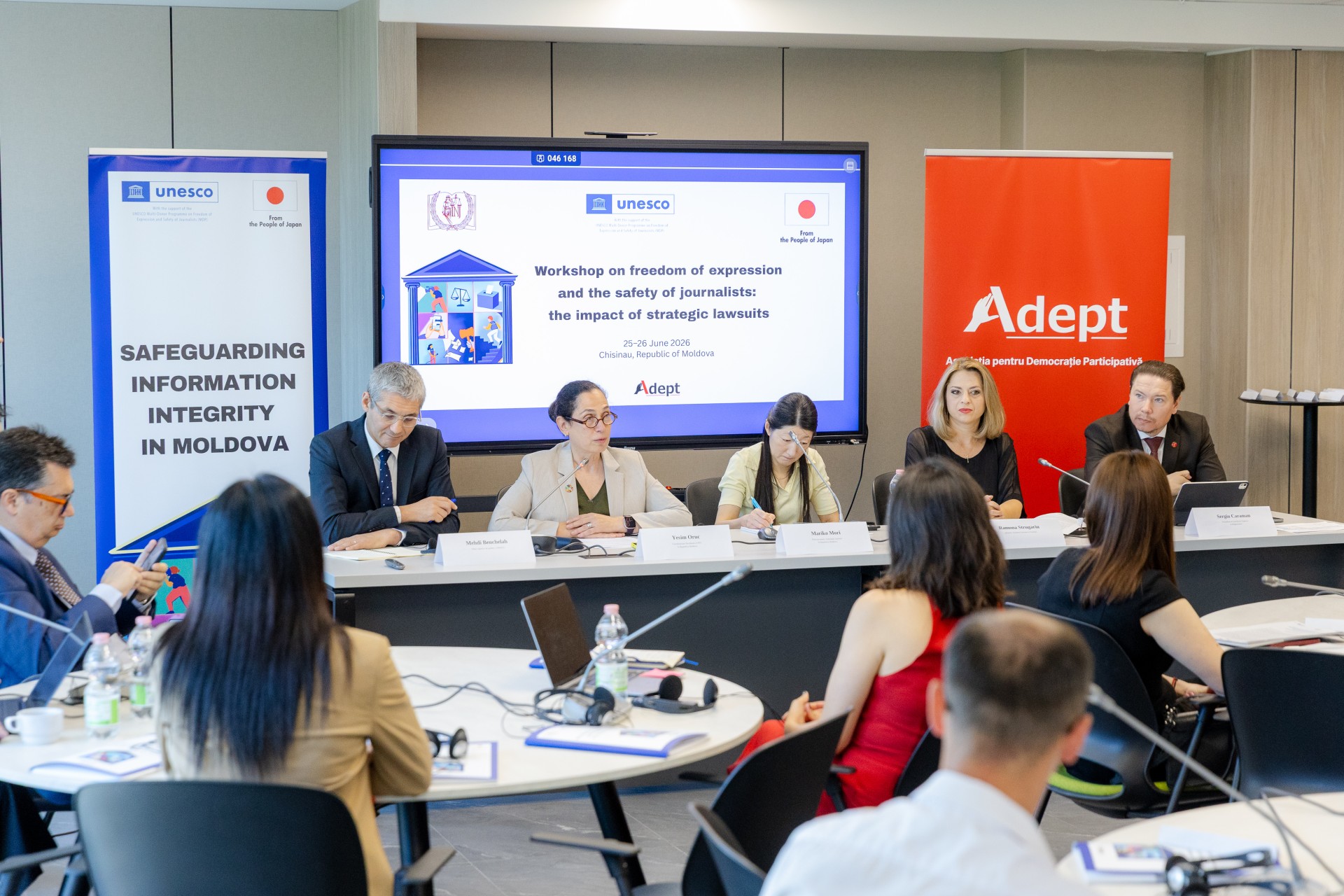
Judges, prosecutors and lawyers from the Republic of Moldova are taking part in a two-day workshop on identifying and countering Strategic Lawsuits Against Public Participation (SLAPPs), organized by the National Institute of Justice and UNESCO on 25–26 June 2026, in partnership with the Association for Participatory Democracy ADEPT.
The workshop equips participants with practical tools to identify abusive legal actions and apply international and European standards on freedom of expression and the protection of journalists.
The need for such training is increasingly urgent. As Moldova is developing its first anti-SLAPP legislation, judicial actors will play a key role to ensure that journalists and human rights defenders are effectively protected from abusive legal practices, designed to exhaust them financially and psychologically rather than to succeed on legal grounds. The workshop directly supports the implementation of the Republic of Moldova's first National Action Plan on the Safety of Journalists (2026–2027), an inter-institutional framework coordinated by the Ministry of Culture, the Ministry of Internal Affairs, Ministry of Justice and Office of the Prosecutor to strengthen the protection of media professionals against intimidation and unlawful interference.
Ramona Strugariu, Director of the National Institute of Justice, highlighted the importance of strengthening dialogue between the judiciary and the media. "Dialogue between the press and the justice system must be based on mutual respect and on a shared commitment to truth and to keeping the public accurately informed. Judicial practice should reflect this responsibility. Recognizing abusive lawsuits and applying appropriate sanctions are essential tools for protecting freedom of expression and strengthening the rule of law."
Sergiu Caraman, President of the Superior Council of Magistracy, emphasized the judiciary's responsibility to safeguard freedom of expression. "Justice must ensure the effective protection of freedom of expression while maintaining a fair balance with other fundamental rights. It is essential that legal professionals understand international standards and are able to dismiss abusive proceedings at an early stage."
The workshop also highlights the critical role of investigative journalism in exposing corruption and organized crime. Participants examine international cases involving money laundering, corruption and organized crime in which investigative reporting played a decisive role. Discussions also underline that journalists continue to face heightened risks, as they have historically lacked the systematic legal safeguards available to many public officials.
"Think about this: without the work of journalists, your work as judges would be much more difficult. Journalists investigate issues that institutions cannot always uncover. That relationship is essential, and so is their protection," said Ramona Strugariu.
Highlighting the growing global trend of abusive litigation, Mehdi Benchelah, UNESCO Senior Project Officer for Freedom of Expression and the Safety of Journalists and Head of the Rule of Law Team, said: "What we are discussing are sophisticated new forms of attacks against journalists. These attacks are not designed to win in court. They are designed to drain media organizations financially and over time, and to intimidate independent media. This trend is growing globally, making stronger legal safeguards essential to counter it."
Yesim Oruc, United Nations Resident Coordinator in the Republic of Moldova, stressed that protecting journalists requires more than legislative reform. "In recent years, journalists have faced new challenges, including digital surveillance, online violence and cybercrime. The time has come to move beyond normative reforms and deliver tangible results by strengthening implementation capacity, improving institutional coordination and reinforcing administrative effectiveness. Our role is to help ensure that reforms translate into concrete action that genuinely benefits journalists, media organizations and citizens."
Mariko Mori, First Secretary of the Embassy of Japan in the Republic of Moldova, reaffirmed the importance of protecting press freedom in democratic societies. "Journalists are often unwelcome to those who exercise power in undemocratic ways. They face growing pressure at a time when freedom of expression is becoming increasingly vulnerable. Laws must serve the interests of all citizens, not particular interests. That is why it is essential for justice professionals to understand these challenges."
The programme combines interactive deliberation sessions, moot courts, case studies and scenario-based practical exercises with comparative analysis of international jurisprudence. Participants receive training on international and European standards on freedom of expression, practical methods for identifying abusive legal actions and the implementation of the EU Anti-SLAPP Directive (EU) 2024/1069, which is currently being transposed into the national legislation of the Republic of Moldova.
The UNESCO project on safeguarding information integrity in Moldova benefits from the support of the government of Japan and of UNESCO’s Multi-Donor Programme on Freedom of Expression and Safety of Journalists and is implemented in partnership with Association for Participatory Democracy ADEPT.